The map
Where the ideas come from
Each mark is a source. Filled marks are sources Jung documented using; rings are parallels with no link to Jung that we could find; squares are later work built on him. Threads run into the Jung work that drew on a source, out to work that built on it, and, dashed, from an unlinked parallel to the later Jungian who connected it.
Modern takes and deeper reading
Books, essays, research and media that carry the poster's ideas forward, refine them, test them or argue with them. Filter by region of the map or by kind.
How to read this page
The link labels
What the poster adds to Jung
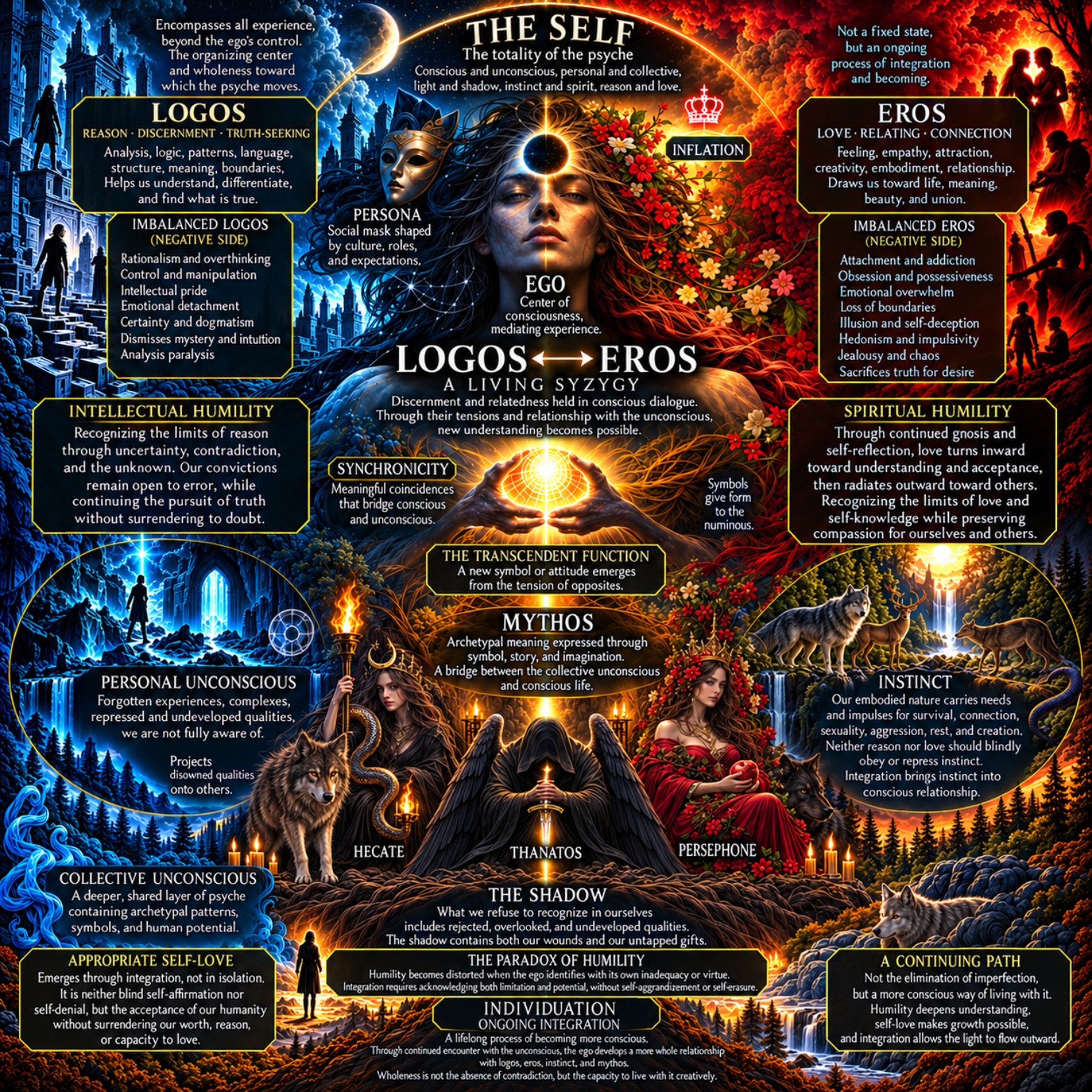
Jung did pair Logos and Eros, as the principles behind animus and anima, but he assigned them to masculine and feminine consciousness. The poster places both inside every ego, which follows later post-Jungian revisions. Its chain from the syzygy through the transcendent function into Mythos is the poster's own synthesis, though it sits well with Jung: he contrasted directed thinking in words with fantasy thinking in images, wrote of a uniting symbol arising between opposites, and treated myth as the psyche's own speech. Intellectual humility, spiritual humility and appropriate self-love are not Jung's terms. The closest Jungian name for one side of the paradox of humility is negative inflation, and Jung's own version of appropriate self-love is the self-acceptance of “Psychotherapists or the Clergy” (1932).
The latest edition seats three Greek figures between Mythos and the Shadow: Hecate, Thanatos and Persephone. Jung wrote about all three as images of the depths, Hecate as the mother's dark side, Persephone as the Kore, and death as a goal of life's second half, but the poster gives them no captions, and the threads that tie them into the map are this page's reading of where the poster sets them.
The two unlabeled symbols on the map (the eclipsed brow and the wanderer) are our readings of the artwork, marked as such. So is the title of Symbols, which the poster writes only as a caption.
What this page adds
In Jung's terms myth is how the archetypes of the collective unconscious show themselves, and the revised poster draws exactly that: Mythos sits at the center as a bridge between the collective unconscious and conscious life, fed by synchronicity, symbols and the transcendent function. The latest edition of the poster paints no arrows, so this page draws them all in gold, with their key, among them a few threads where the poster's argument implies a link it never painted: the first leg of the mythic current, from the collective unconscious up into synchronicity; the bond between instinct and the collective layer; a thread from the personal unconscious into Eros; and threads tying Hecate to the personal unconscious, Thanatos to Eros and Persephone to Instinct.
The depth view is this page's redrawing, not the poster's. The Self is the outer ring, since for Jung nothing in the psyche lies outside it, and its center is marked too, joined to the ego by the ego–Self axis. The current rises from the collective unconscious through synchronicity and the Self's center, crosses into consciousness through the transcendent function and the symbols, and reaches Mythos. Anima and animus, missing from the poster, appear as guides between the ego and the deep, complexes sit in the personal layer tied to their archetypal cores, and the unus mundus sits just outside the circle because Jung offered it only as a hypothesis.
Later additions bring in post-Jungian and modern psychology. A cultural layer sits between the personal and the collective unconscious, dreams and active imagination sit on the threshold of consciousness, and another person stands at the edge, touching the Self; choosing them shows Jung's square of two people in relationship. Under Layers, the spectrum draws Jung's scale from instinct to spirit, and the individuation spiral winds in toward the Self's center, with a short walk along it. The evidence lens grades each region of the depth view as echoed by research, reframed by it, or contested or untested. The grades are this page's summary of the research cited in each reading, not a formal review.
Caveats
“No link found” means we found no evidence that Jung used a source. It does not prove he never read it. Jung's words are paraphrased throughout, with Collected Works (CW) volume and paragraph numbers where they are known. The collective unconscious and synchronicity remain contested, and the library includes critical work alongside sympathetic work, as well as the debate over Jung's statements and conduct in the 1930s.
This page is for study and reflection. The practices are small exercises, not therapy.
Install and offline
You can keep this page as an app. In Chrome or Edge, use Install at the top of the page; on an iPhone or iPad, use Share, then Add to Home Screen. After one visit, the map, the readings, the timeline and the library also work offline. Links out to the sources still need a connection.
Listen reads with the voices on your device. Online voices, such as the natural ones in Edge, need a connection; without one, a voice on the device takes over.